Disposable Cameras at Your Wedding: Real Costs and the Alternative
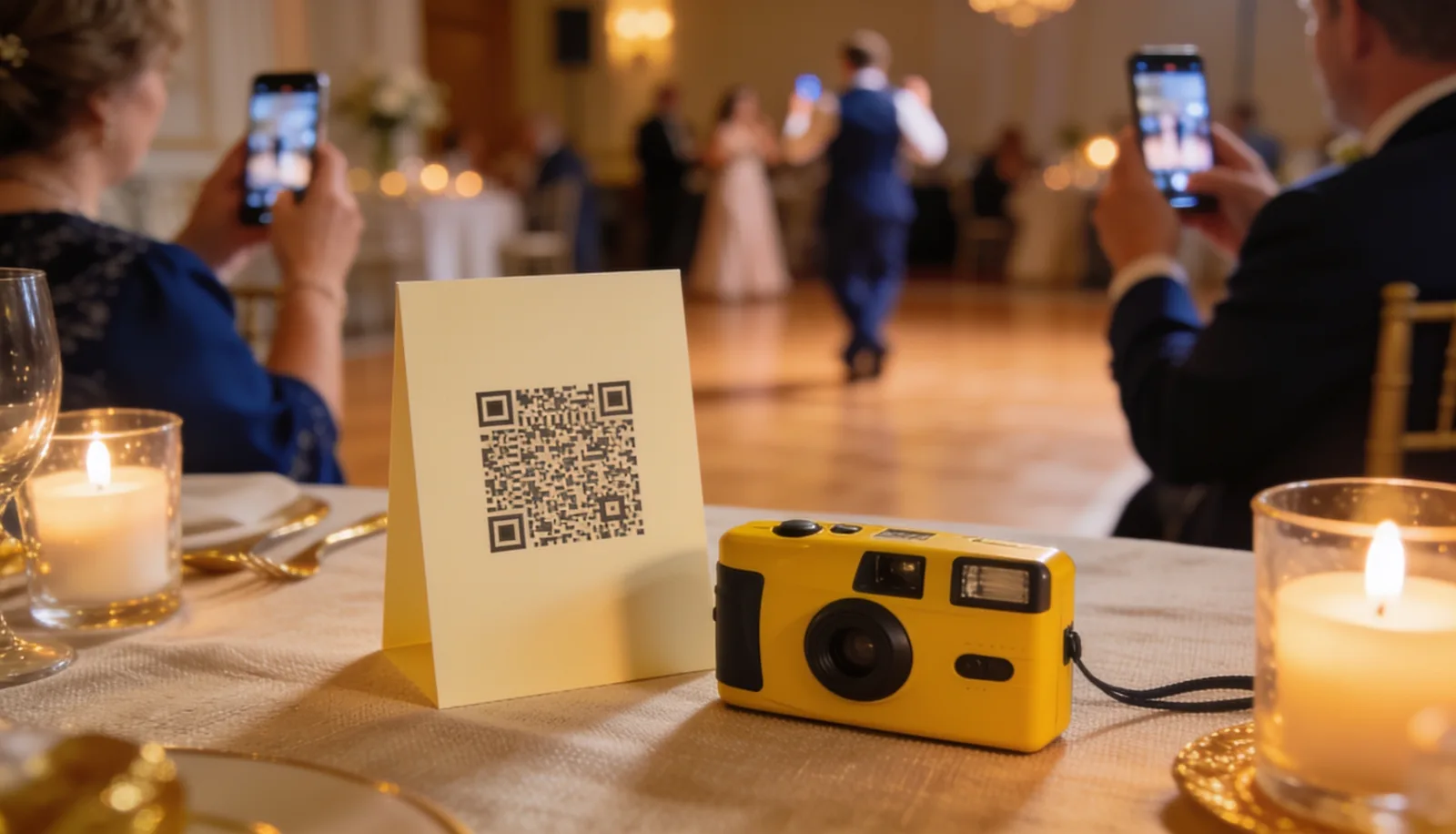
Ten disposable cameras with developing run roughly $234 to $351 in the US, you wait two to five weeks for the photos, and photographers report that a third to half of the cameras never make it back to you. A QR-based disposable camera alternative for your wedding gathers every guest's phone photos in one album with no app and no login. Lane of Memories is a one-time $149 and shows the pictures live on the big screen during the party.
On this page
The photos from your wedding already exist. They are just scattered across twenty different phones, and on film inside disposable cameras that may never make it back to your table at the end of the night. The question is not whether your guests take pictures. They do, constantly. The question is whether you ever get to see them.
Disposable cameras have had a full-blown revival at weddings, and it is easy to see why: they are nostalgic, tactile, and fun. But before you set one on every table, it is worth running the numbers on what they actually cost, and how many keepable photos you are left with once the developing is paid for.
We ran the math on all four common ways to collect wedding photos from guests: disposable cameras, photo-sharing apps, a shared album or hashtag, and QR-code sharing. Here is the whole picture, with sources, so you can choose a disposable camera alternative for your wedding with your eyes open.
Quick overview: four ways to collect wedding photos from guests
Method | Cost (approx.) | Guests need | When you see the photos |
|---|---|---|---|
Disposable cameras | $234–$351 for 10–13 with developing | Nothing — just click | 2–5 weeks after the party |
Photo-sharing app | Free app, downloads cost extra | To download an app | Rolling, inside the app |
Shared album / hashtag | Free | The right app or account | Rolling, but messy |
QR sharing (Lane of Memories) | $149 — one-time | Just their phone camera | Live on the big screen |
The numbers in the table are backed up with sources in the sections below. Let's start with the camera that kicked off the trend.
How much do disposable cameras cost at a wedding?
The camera is only half the bill. Digital-disposable app Later Cam cites Walmart pricing of $24.96 for a Fujifilm 2-pack, or $12.48 per camera, with in-store development at $10.96 including prints. That works out to $23.44 per camera, or about $234 for ten. LA film wedding photographer David Cruz reports a similar range: a Fujifilm 10-pack runs $193 and a Kodak 7-pack $179, with development and scanning about $15 per camera.
The developing is where the surprises hide. Beyond a big-box lab, pix.wedding lists film developing at $12 to $18 per roll at one-hour labs, or $8 to $12 mail-order, plus a $20 to $40 scanning fee per order. So a typical ten-camera setup shakes out like this:
- 10 cameras at $12.48 each: $124.80
- Development with prints at $10.96 each: $109.60
- Total: about $234 — before you know whether a single shot came out
Scale that up and it climbs fast. Digital-disposable app Scene, in its own 2026 cost breakdown, puts a 100-guest wedding at 13 cameras for a total of $351, with roughly 65 percent of photos usable — about $1.54 per keepable photo. QR competitor GuestPix estimates even higher, claiming a typical wedding uses 15 to 30 cameras at $15 to $25 each plus $12 to $20 to develop, easily $600 to $1,200 — though as a competitor's marketing figure, treat that as the top end, not the norm.
How many cameras do you need for 50 to 60 guests?
Wedding studio Aesthetic Sabotage recommends 8 to 10 cameras for a 100-guest wedding, calling it a $250 to $350 investment. For 50 to 60 guests that means roughly 4 to 5 cameras — around $100 to $150 with developing, and a hard ceiling of about 108 to 135 exposures to cover the whole night. As we'll see, not all of those exposures turn into photos you actually want to keep.
How good are the photos from a disposable camera, really?
Here is the part few people mention before the wedding. That same studio, Aesthetic Sabotage, reports that about 30 to 50 percent of cameras never make it back to you by the end of the night — they go home in purses and jacket pockets. QR service pix.wedding says from its own experience that 2 to 4 cameras go missing at the average wedding, and 20 to 30 percent of indoor evening shots come out too dark or blurry to use.
Photographer David Cruz tells of one couple who set out ten cameras with 270 exposures and ended up with roughly ten usable pictures — about $15.50 per photo. His diagnosis: the lab charges full price whether one shot or all 27 came out, and party guests forget to turn the flash on. That flash is the whole game — without it, indoor shots come out dark. If you do use disposables, print the reminder right on the table card.
None of this is to write the disposable camera off. It is a genuinely fun activity, the grainy film look is charming, and a developed print is a physical keepsake no cloud folder can match. The problem is not the camera. It is making the camera your entire plan for collecting photos.
Wedding photo-sharing apps: free is rarely free
The next category is dedicated wedding apps that guests upload to. The best-known, Wedbox, has an app that is free for everyone before, during and after the event — but full-quality downloads cost $19.99 for a single package or $49.99 for multiple, and files are stored free for only two months after the wedding, then $2.50 a month after that.
The bigger hurdle is the app itself. UK platform Posable, which sells photo sharing of its own, concedes in its review that couples report only a small percentage of guests actually contribute to app-based galleries. Your 74-year-old aunt is not going to download an app in the middle of the entrée — and, honestly, neither is the college crew.
Shared albums and hashtags: simple, but messy
The free option is a shared Google Photos album or an Instagram hashtag. It costs nothing, but it has two weak spots. That same Posable review describes shared Google Photos albums as disorganized when many people upload — everything lands in one long stream with no curation. And a hashtag requires guests to post publicly from their own account, which many will not do, and leaves you hunting down and saving each photo by hand afterward.
A shared album works fine as a backup, but as your main method it gives you neither a clean gallery, strong participation, nor anything to show off during the party.
QR code for wedding pictures: scan, upload, done
The fourth method removes the barrier entirely. Guests open the phone camera, point it at a QR code on the table, and follow the link straight to a shared album — exactly as wedding portal The Knot describes the method. No app, no account, no hashtag. The Knot recommends displaying the code on signage, TV screens and in the wedding program, and names services like Wedibox, GuestPix and WedUploader in this category.
Prices run consistently below the camera packs. GuestPix charges $49 (Classic) up to $119 (Signature Bundle) as a one-time payment, and Wedibox has a free tier capped at 50 uploads, with paid plans at $49 and $79 — no app or login for guests either. Participation is not perfect here either — pix.wedding reports from its own data that 35 to 45 percent of guests take part when the code is clearly placed — but every photo is sharp, digital, and available the same night.
Lane of Memories: photos straight to the big screen
Lane of Memories is a QR-based option with one difference guests notice right away: the photos do not disappear into an album you look at later — they pop up in a live slideshow on the big screen while the party is happening. Guests scan one code, with no app and no login, and can share photos and write greetings that together become a digital guest book from the night.
The album stays open for 30 days after the party with full-resolution download of every photo, and a ready-made printable card template with the QR code is included, so you just print it and set it on the tables. The price is a one-time $149 per event — no subscription, no paywall in front of your own pictures. For comparison, ten disposable cameras with developing came to roughly $234 to $351, with a two- to five-week wait.
The numbers at a glance
Everything one QR code gives you
No app, no login
Guests just scan the QR code with their phone camera and they're straight in.
Live on the big screen
Photos and greetings appear in a live slideshow while the party is happening, not the next day.
Song requests via Spotify
Guests can request tracks through the very same code — no extra app.
A personalized song
Answers to a few simple questions are automatically turned into a personalized song, performed karaoke-style on screen.
How to get started with QR sharing: step by step
Setting up photo sharing with a QR code
Create your event
Pick a service and set up your wedding. The QR code is generated automatically — you do not make it yourself.
Print cards for the tables
Use a ready-made template (included with Lane of Memories) and print one card per table, plus a few extras.
Test with your own phones
Scan the code with two or three different phones and upload a test photo, so you know everything works.
Have the MC say it out loud
A quick line during the welcome — 'scan the code on your table and share your photos' — lifts participation more than any sign.
Download the album afterward
With Lane of Memories the album stays open for 30 days, with full-resolution download of every photo.
Where should you place the QR code?
Placement drives participation. The Knot recommends signage, TV screens and the wedding program, and notes that ready-made sign templates run $4 to $16 on Etsy, Amazon and Canva — with Lane of Memories the template is included. Here are the spots that work best:
The QR code's best spots
One code, the whole night
What surprises a lot of couples is that the QR code can do more than collect photos. With Lane of Memories the same code runs the whole evening's entertainment: guests can play a quiz about the couple with a live leaderboard on the big screen, request songs via Spotify, and answer personal questions that are automatically turned into a personalized song, performed karaoke-style on screen toward the end of the night.
And if you really want to get the photos flowing, you can turn collecting them into a game: a photo scavenger hunt with specific missions for your guests brings pictures from every corner of the room, not just from the table nearest the dance floor.
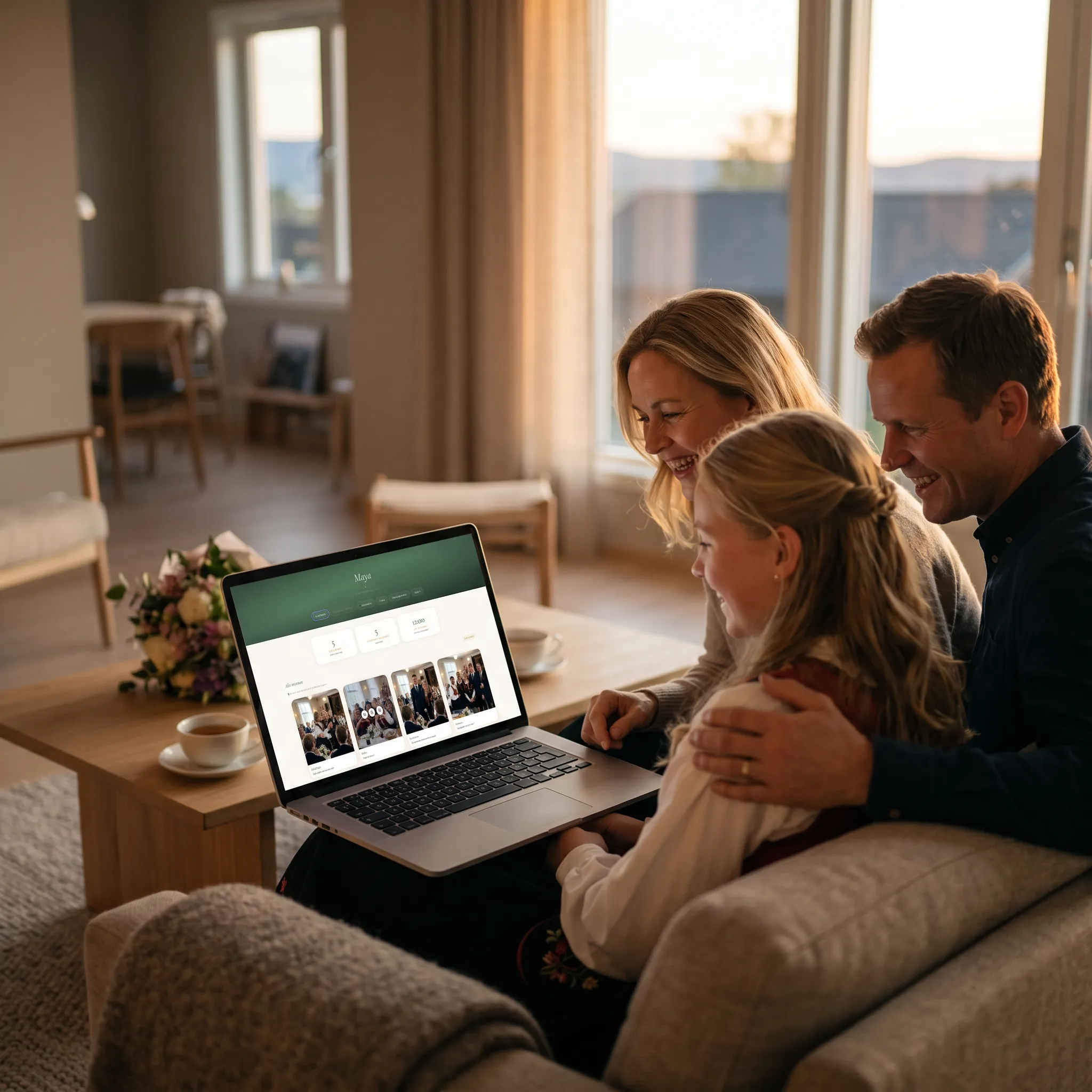
The lights dip
The music lifts a notch, and the first photo of the night appears on the big screen.
Everyone sees the same moment
A shot from the dance floor, shared thirty seconds ago by a guest at table six.
The greetings scroll past
Between the photos, short messages drift in from the ones who never quite got the mic for a toast.
Which method should you choose?
The honest answer is that it depends on what you're after. Here's our short rule of thumb:
- Choose disposable cameras if the analog look is the whole point, the budget can handle $234 to $351, and you can wait a few weeks for the results.
- Choose a photo-sharing app if your guest list is young and digital, and you don't need to show the photos during the party.
- Choose a shared album if the budget is zero and you can live with some mess — and keep it as a backup regardless.
- Choose QR sharing if you want every guest to take part with no app, want to see the photos on the big screen the same night, and want it all in one album afterward.
Whatever you land on: decide before the invitations go out, test the setup well in advance, and give the MC the job of reminding guests. The photos from your wedding are going to be taken either way — the difference is whether they end up with you, or stay stranded on twenty phones and three lost cameras.
We're rooting for you — and for every crooked, happy, unfiltered picture your guests are about to take.
Sources
- Later Cam — Walmart camera and developing prices
- David Cruz — camera packs and cost per usable photo
- Scene — disposable camera cost breakdown
- GuestPix — camera cost estimate and QR pricing
- GuestPix — QR gallery pricing
- Aesthetic Sabotage — return rate, camera count, low light
- pix.wedding — developing costs, missing cameras, QR participation
- Wedbox — app pricing and storage window
- Posable — participation in app-based galleries
- Wedibox — QR pricing and free tier
- The Knot — the QR method, signage and templates
Frequently asked questions
Are disposable cameras worth it at a wedding?
They are fun and nostalgic, but they are not a reliable way to collect photos. LA wedding studio Aesthetic Sabotage reports that 30 to 50 percent of cameras never make it back to you by the end of the night, and film photographer David Cruz describes one couple who set out ten cameras and ended up with about ten usable pictures. They make a charming extra, but most couples pair them with a digital method that actually captures the night.
How do I get pictures from my wedding guests?
The four common methods are disposable cameras, photo-sharing apps, a shared album or hashtag, and QR-code sharing. QR sharing has the lowest barrier because guests just scan a code with their phone camera, with no app or account. With Lane of Memories the photos land in one shared album and appear at the same time in a live slideshow on the big screen during the party.
How does a QR code work for wedding photos?
As The Knot explains, guests open the camera app on their phone, point it at the code, and follow the link to a shared album where they upload their pictures. You do not create the code yourself: the service generates a unique one for your event. With Lane of Memories a printable card template with the QR code is included, so you just print it and set it on the tables.
Do guests need to download an app to share wedding photos?
Not with QR-based sharing. Services like Lane of Memories, Wedibox and GuestPix let guests scan a code and upload straight from the phone camera, with no app and no login. That matters because participation is the weak point of app-based galleries: as Posable notes, couples often report that only a small percentage of guests actually contribute when an app download is required.
How much do disposable cameras cost to develop?
It varies by lab. Later Cam cites Walmart at $10.96 per camera with prints, while pix.wedding lists film developing at $12 to $18 per roll at one-hour labs, or $8 to $12 mail-order, plus a $20 to $40 digital scanning fee per order. Add the camera itself and you are looking at roughly $23 or more per camera before you know whether a single shot came out.
Related articles
Wedding Song Requests From Guests: The Full Playbook
A practical guide to wedding music: how to build the playlist, pick a first dance, and collect song requests from guests without the DJ booth turning into a line.
Wedding Toast Order: Who Speaks When (Full Guide)
Who gives the first toast at a wedding, and how long should each one run? Here's the traditional order, recommended toast lengths, and a ready-made timeline to copy into your reception.
Wedding Emcee Tips: How to MC a Reception
The wedding emcee job is about timing, not talent: here's the reception timeline, toast order, and rookie mistakes to avoid so the night runs smoothly.